Social Media Audit Template (2026)
An 8-metric framework to evaluate every platform, identify what is working, and fix what is not. No spreadsheet download required -- everything you need is on this page.
No credit card required · 7-day free trial · Plans from $19/mo

What Is a Social Media Audit?
A social media audit is a systematic review of every social media account your brand owns, measuring performance metrics, content effectiveness, audience alignment, and competitive positioning to identify what is working, what is underperforming, and where to focus resources next.
Think of it as a health check for your social media presence. Just as a financial audit reveals where money is being spent wisely and where it is being wasted, a social media audit exposes the platforms, content types, and posting habits that generate real business value versus the ones that consume time without delivering results. Most businesses post across three to six platforms but rarely step back to evaluate whether each platform deserves the attention it receives. The audit process forces that evaluation with data rather than gut feeling, replacing assumptions about what works with evidence about what actually drives engagement, traffic, and conversions. Without regular audits, businesses tend to keep doing what they have always done, even when platform algorithms, audience behavior, and competitive landscapes have fundamentally changed around them.
 Sprout Social recommends conducting audits at least quarterly
, noting that brands who audit regularly see measurably higher engagement rates because they continuously eliminate underperforming content and double down on what resonates. The quarterly cadence gives you enough data for meaningful trend analysis while keeping your strategy agile enough to respond to platform changes.
Sprout Social recommends conducting audits at least quarterly
, noting that brands who audit regularly see measurably higher engagement rates because they continuously eliminate underperforming content and double down on what resonates. The quarterly cadence gives you enough data for meaningful trend analysis while keeping your strategy agile enough to respond to platform changes.
The 8 Metrics That Matter Most in a 2026 Social Media Audit
Vanity metrics like raw follower count and total impressions tell you very little about whether your social media strategy is actually working. The eight metrics below form a complete diagnostic framework that covers growth, engagement, content quality, operational consistency, and competitive standing. Score each platform on every metric using a simple one-to-five scale, then total the scores to rank your platforms objectively. This framework works whether you manage one platform or ten, and it scales from solo entrepreneurs to agencies managing dozens of client accounts. HubSpot research confirms that businesses tracking multiple performance metrics are significantly more likely to receive increased budgets because they can demonstrate measurable progress to stakeholders rather than relying on anecdotal evidence about social media effectiveness.
Audience Growth Rate
Percentage change in followers over the audit period. Net new followers divided by starting follower count, multiplied by 100. Healthy benchmarks: 2-5% monthly for established accounts, 5-15% for newer accounts actively posting.
Engagement Rate
Total interactions (likes, comments, shares, saves) divided by impressions or reach. This is the single most important metric because it reflects content resonance and directly influences algorithmic distribution. Aim for above 1% on most platforms, above 3% on LinkedIn.
Content Mix Ratio
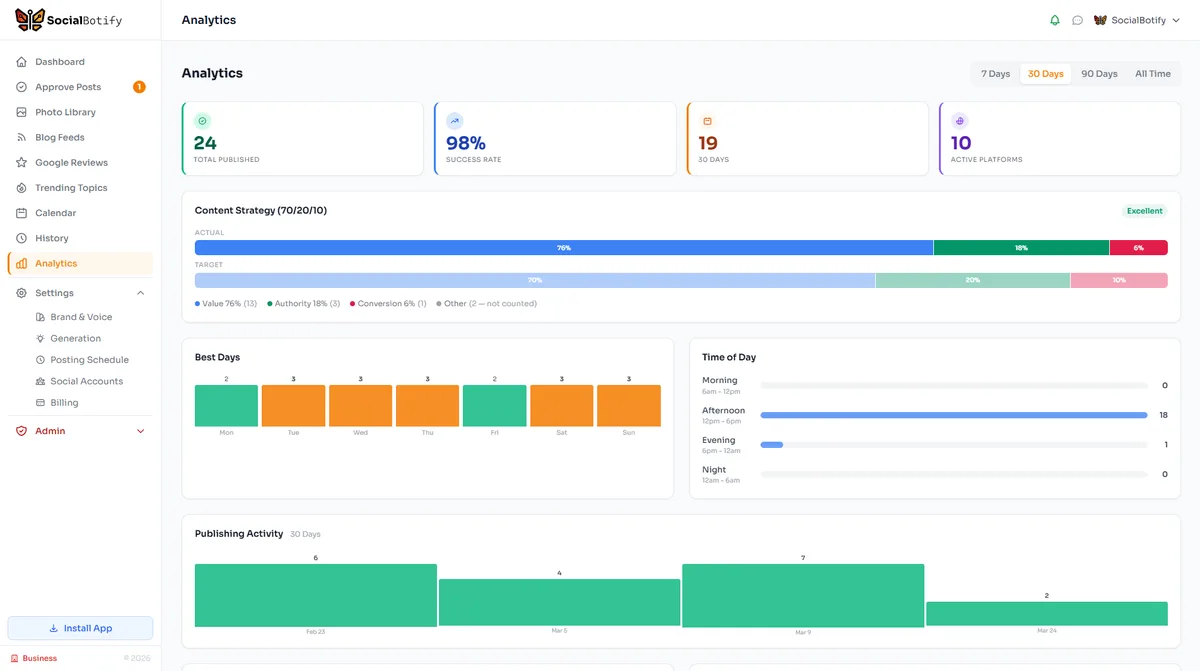
The balance between educational, promotional, and engagement content. A healthy mix follows the 70/20/10 rule: 70% value-driven content, 20% curated or shared content, 10% direct promotion. If your promotional content exceeds 30%, engagement will suffer. Use your content strategy to rebalance.
Posting Consistency
Percentage of scheduled posting slots that were actually filled during the audit period. Gaps in your posting schedule signal to algorithms that your account is inactive, reducing reach on subsequent posts. A score below 80% means you need automation to maintain consistency.
Click-Through Rate (CTR)
Link clicks divided by impressions. Measures whether your content drives action beyond passive consumption. Strong CTR on link posts: above 1% for organic content, above 2% for paid. If CTR is low but engagement is high, your calls-to-action need work.
Audience Demographics Alignment
How closely your follower demographics match your ideal customer profile. Check age ranges, locations, job titles (on LinkedIn), and interests. A mismatch means your content is attracting the wrong audience, which explains high follower counts paired with low conversion rates.
Brand Voice Consistency
A qualitative review of whether your tone, messaging, and visual identity are consistent across platforms. Inconsistency confuses your audience and weakens brand recognition. Score this by reviewing 10 random posts per platform and rating voice alignment on a 1-5 scale.
Competitor Benchmark Gap
Compare your metrics against two to three direct competitors on each platform. Note where you outperform them and where you fall behind. The gap reveals opportunities: if a competitor gets high engagement on a content format you have never tried, that is your lowest-hanging fruit for improvement.
How Do You Conduct a Social Media Audit Step by Step?
A thorough social media audit does not need to take days. With the right framework and data sources prepared in advance, most businesses can complete a comprehensive audit in two to three hours. The process below walks you through each stage from initial account inventory through final action planning. The key is being systematic rather than jumping straight to the metrics you care about most, because the biggest opportunities often hide in the areas you have been ignoring. Every step builds on the previous one, so resist the temptation to skip ahead. By the time you reach the action plan stage, you will have a clear picture of which platforms deserve more investment, which need strategic changes, and which might be better abandoned entirely so you can redirect those resources to higher-performing channels.
Inventory Every Account
List every social media profile your brand owns across all platforms. Include active accounts, dormant profiles, and any unofficial pages created by employees or fans. Record the URL, username, follower count, and last post date for each. You may discover forgotten accounts or duplicate profiles that confuse customers searching for your brand.
Pull 90 Days of Performance Data
Export analytics from each platform covering the last 90 days. Collect impressions, reach, engagement actions, link clicks, follower growth, and any conversion data available. Use native platform analytics or a tool like SocialBotify that centralizes data across all connected accounts. Ninety days gives you enough data to identify real trends rather than reacting to normal week-to-week variation.
Score Each Platform on the 8-Metric Framework
Rate each platform one through five on every metric listed above. Be honest -- inflating scores defeats the purpose. A platform with 50,000 followers but a 0.3% engagement rate should score low on engagement regardless of the follower number. Total the scores to get a platform health rating out of 40.
Identify Top and Bottom Performers
Rank your platforms by total score. Flag the top two generating the most business value and the bottom two consuming resources without returns. Platforms scoring below 20 out of 40 need either a strategy overhaul or should be paused so you can redirect effort to winners.
Analyze Content Performance Patterns
Review your top 10 and bottom 10 posts across all platforms. Look for patterns in content type (text vs. image vs. video), topic, length, posting time, and call-to-action style. The patterns that emerge here directly inform what you should create more of and what you should stop doing.
Build Your Action Plan
Create a prioritized list of changes based on your findings. Set specific targets for each metric, define the content changes needed, and schedule your next audit in 90 days. Feed your findings into your content calendar template to translate insights into a concrete posting plan for the next quarter.
Social Media Audit Checklist
Use this checklist to make sure you cover every aspect of your audit.  Hootsuite recommends a structured checklist approach
because it prevents you from skipping areas that feel less urgent but often contain the most impactful improvement opportunities. Work through each category in order, checking off items as you complete them.
Hootsuite recommends a structured checklist approach
because it prevents you from skipping areas that feel less urgent but often contain the most impactful improvement opportunities. Work through each category in order, checking off items as you complete them.
■ Account Health
- ✓ All profiles use current logo, bio, and website URL
- ✓ No duplicate or unauthorized profiles exist
- ✓ Usernames are consistent across platforms
- ✓ Admin access and login credentials are documented securely
■ Content Performance
- ✓ Top 10 performing posts identified with common traits noted
- ✓ Bottom 10 performing posts reviewed for patterns to avoid
- ✓ Content mix ratio calculated (educational vs. promotional vs. engagement)
- ✓ Optimal posting times identified per platform
- ✓ Posting frequency compared to platform benchmarks
■ Audience Analysis
- ✓ Follower demographics reviewed against ideal customer profile
- ✓ Audience growth rate calculated for each platform
- ✓ Unfollower trends and spikes investigated
- ✓ Most engaged audience segments identified
■ Competitive Position
- ✓ 2-3 competitors benchmarked on follower count and engagement rate
- ✓ Competitor content formats and topics reviewed for gaps
- ✓ Platforms where competitors are absent identified as opportunities
■ Operations & Efficiency
- ✓ Weekly hours spent on social media management tracked
- ✓ Tool stack reviewed for redundancies and gaps
- ✓ Cost per acquisition calculated per platform
- ✓ Automation opportunities identified for repetitive tasks
What Should You Do After a Social Media Audit?
An audit without action is just a report that collects dust. The real value comes from translating your findings into concrete changes to your content strategy, posting schedule, and platform allocation. Start with the three changes that will have the highest impact based on your scores. If posting consistency scored low, set up automated scheduling before anything else because consistency is the foundation every other metric depends on. If engagement rate is weak but your posting frequency is already solid, the issue is content quality and your action plan should focus on testing new formats, improving hooks and opening lines, and adjusting your content mix ratio toward more value-driven posts that spark conversation rather than promotional content that audiences scroll past.
Your audit results should feed directly into a content calendar template for the next quarter. Map your top-performing content types to specific days, allocate more slots to your strongest platforms, and build in experimental slots to test the content formats your competitors are succeeding with that you have not tried yet. The calendar becomes the operational plan that turns audit insights into daily action, closing the loop between analysis and execution.
The most common mistake after completing an audit is trying to fix everything at once. Prioritize ruthlessly. Choose three metrics to improve over the next 90 days and ignore the rest until your next audit cycle. Spreading effort across eight improvements simultaneously means none of them get enough attention to produce measurable results, and you end up with the same scores next quarter wondering why nothing changed despite all the work you put in.
Frequently Asked Questions
How often should you conduct a social media audit?
You should conduct a full social media audit quarterly, with lightweight metric reviews monthly. Quarterly audits give you enough data to identify meaningful trends while keeping your strategy responsive to platform algorithm changes. Monthly check-ins on key metrics like engagement rate and follower growth help you catch problems early before they compound into larger performance issues.
What is the most important metric in a social media audit?
Engagement rate is the single most important metric because it reflects whether your content resonates with your target audience. High follower counts mean nothing if those followers do not interact with your posts. Engagement rate also directly influences algorithmic distribution on every major platform, meaning higher engagement leads to greater organic reach without additional spending.
Can I automate parts of a social media audit?
Yes, you can automate data collection and performance tracking, which are the most time-consuming parts of an audit. Tools like SocialBotify track posting consistency, engagement metrics, and content performance across all connected platforms automatically. The strategic analysis and action planning still require human judgment, but automation reduces a two-day audit process to a few hours of focused review.
Ready to Put Your Audit Into Action?
SocialBotify automates the content creation, scheduling, and publishing that your audit tells you to fix. Connect your accounts, set your strategy, and let AI handle the execution across all 10 platforms.
No credit card required · 7-day free trial · Plans from $19/mo