The Problem With "Just Post Something"
Without a strategy, social media becomes a time drain that generates likes but not leads.
100% Value, 0% Revenue
You share tips and insights endlessly but never mention what you sell. Your audience learns from you — then buys from someone else.
Random Topics, No Funnel
Monday is a motivational quote, Tuesday is a tip, Wednesday is whatever you think of at lunch. There's no journey from awareness to conversion.
Engagement Without Conversion
High likes, low sales. Your content entertains but doesn't build the trust and authority that turns followers into customers.
Strategy Fatigue
You know you need a content strategy. You've read the blog posts. But planning one manually for 10 platforms every week? Nobody has time for that.
The core issue with posting without a strategy is that effort does not translate into results. A HubSpot study found that 36% of marketers say their biggest social media challenge is creating content that generates leads, not just engagement. When every post is an isolated idea rather than part of a deliberate sequence, your audience has no reason to move from casually scrolling past your content to actively considering your product or service. The missing piece is a content funnel: a structured progression from awareness-building posts that attract new followers, through trust-building content that establishes your credibility, to conversion-focused posts that give interested prospects a clear next step. Without this progression, you can post five times per week for years and still wonder why social media does not drive revenue for your business.
What Is the 70/20/10 Content Framework?
Used by the world's top marketing teams, this research-backed framework balances three types of content to build trust and drive action.
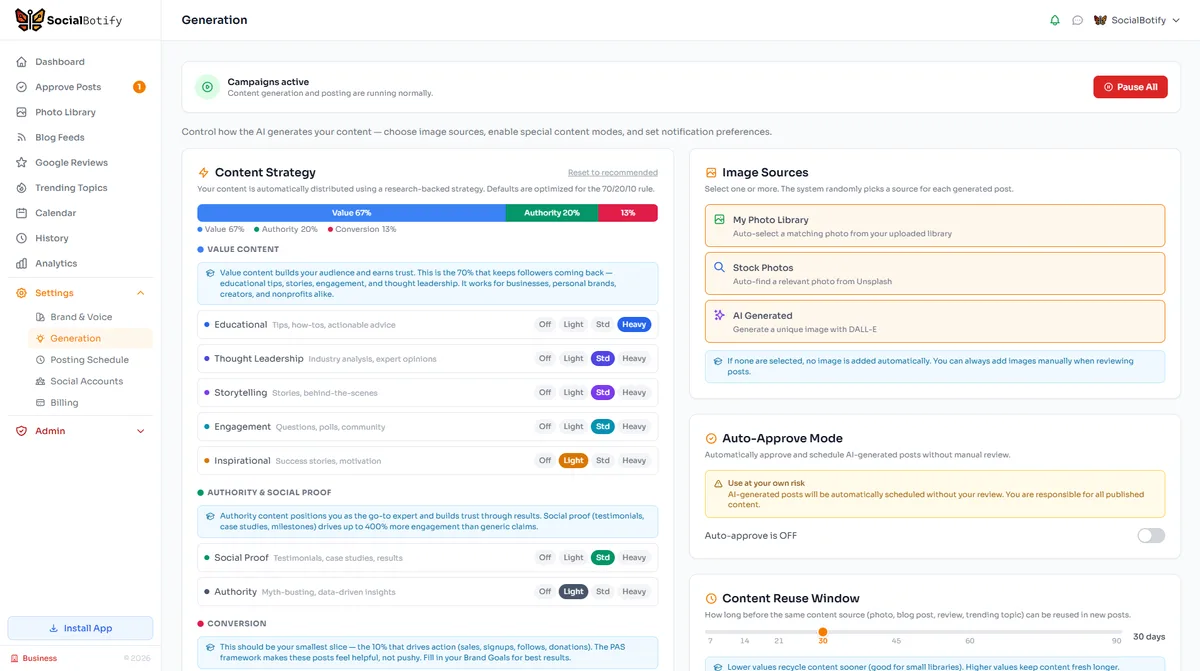
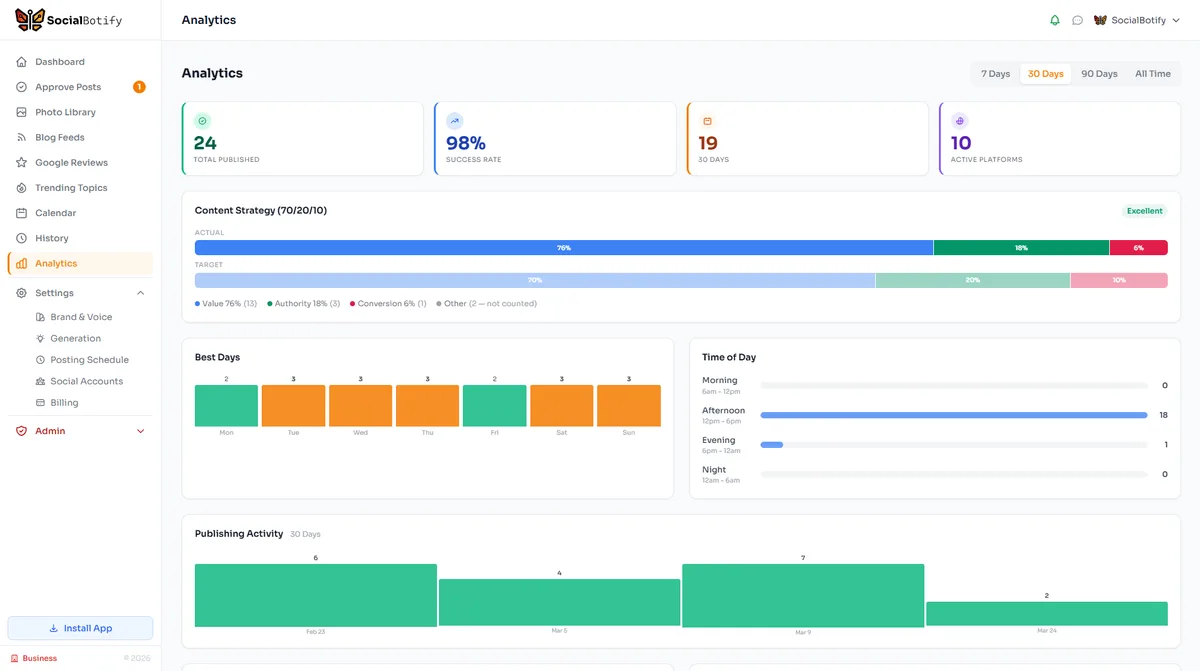
The 70/20/10 content framework divides your social media output into three distinct categories, each serving a specific role in the marketing funnel. Seventy percent of posts deliver genuine value through educational tips, storytelling, and conversation starters that build trust with your audience over time. Twenty percent establish authority using social proof, data-backed insights, and contrarian industry takes that position you as a credible expert. The remaining ten percent drives conversions through soft-sell posts and value-first offers. This ratio works because it mirrors how people actually make buying decisions: they follow accounts that teach them something useful, they trust voices that demonstrate real expertise, and they purchase from brands that have already earned their attention. Companies like Hootsuite and HubSpot recommend variations of this balanced approach as a foundational content strategy.
70% Value Content
The foundation. Content that teaches, inspires, and engages — earning trust before you ever mention what you sell.
- • Educational tips & how-tos
- • Thought leadership & insights
- • Storytelling & behind-the-scenes
- • Engagement & conversation starters
- • Inspirational narratives
20% Authority Content
Build credibility. Show your track record and expertise so when you do ask for the sale, people already trust you.
- • Social proof & testimonials
- • Data-backed authority posts
- • Industry myth-busting
- • Case studies & outcomes
10% Conversion Content
The payoff. Because you've earned trust with the other 90%, these posts actually convert instead of feeling pushy.
- • Soft-sell using PAS framework
- • Value-first offers & CTAs
- • Lead magnets & free resources
- • Natural product mentions
9 Purpose-Driven Content Categories
Every post type maps to a specific goal in your marketing funnel. No filler content — each post earns its place.
Rather than generating generic social media posts, a purpose-driven content strategy assigns every piece of content a specific role in moving your audience from awareness to conversion. SocialBotify organizes content into nine distinct categories, each mapped to the 70/20/10 framework. Educational posts deliver actionable how-to guides your audience can implement immediately. Thought leadership shares bold industry perspectives that set you apart from competitors. Storytelling creates emotional connection through narrative arcs and behind-the-scenes moments. Engagement posts spark genuine two-way conversations. Inspirational content motivates through transformation stories. Social proof showcases client results with specific numbers. Authority posts challenge industry myths using data. Soft-sell content uses the PAS framework to address pain points naturally, while value-offer posts lead with free resources before any call to action. Each category has adjustable weight controls, so you can emphasize the content types that align with your specific business goals and audience expectations.
Educational
Actionable tips, how-tos, and step-by-step guides that solve real problems your audience faces daily.
Thought Leadership
Industry insights and strong takes that position you as the go-to expert — especially effective for LinkedIn content. No fence-sitting.
Storytelling
Human stories with narrative arcs. Relatable moments that create emotional connection with your brand.
Engagement
Conversation starters with genuine questions. Get your audience talking instead of just scrolling past.
Inspirational
Transformation narratives and milestone stories that motivate your audience and humanize your brand.
Social Proof
Testimonials, results, and outcomes with specific numbers. Let your work speak through your clients' success.
Authority
Contrarian takes and myth-busting backed by data. Challenge conventional wisdom to stand out.
Soft Sell
PAS framework (Problem-Agitate-Solution) posts that address pain points and naturally lead to your offering.
Value Offer
Direct CTAs that lead with value first. Because your audience trusts you, these posts drive real clicks.
How SocialBotify Builds Your Strategy
Three steps. Five minutes. A complete content strategy across all your platforms.
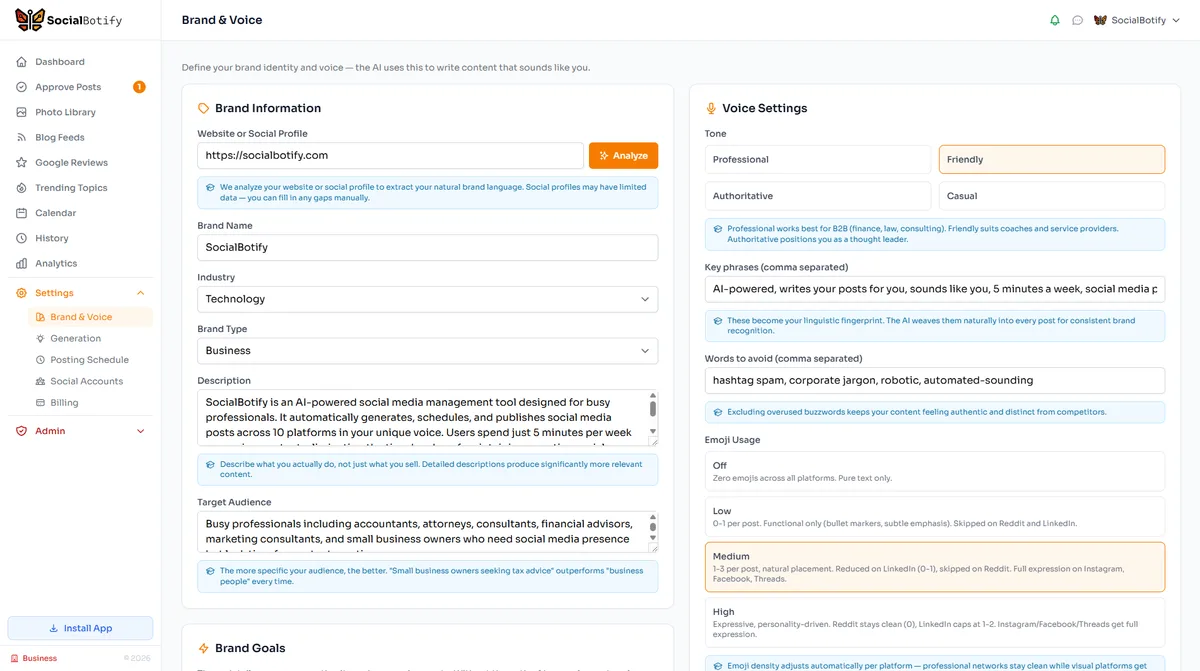
Building a complete social media content strategy with SocialBotify takes roughly five minutes and requires no marketing expertise. The process begins when you enter your website URL or business description, and the AI analyzes your brand voice, industry context, target audience, and competitive positioning to establish a content foundation. Next, you customize the content mix by adjusting weight controls for each of the nine content categories. A consultant might increase thought leadership and authority content, while an e-commerce brand might emphasize social proof and value offers. Once your mix is set, the AI post generator creates an entire week of content across up to ten platforms simultaneously, with each post assigned the appropriate category, psychological writing framework, and platform-specific formatting. You review and approve posts from a visual calendar, and SocialBotify handles scheduling and publishing automatically through its automation engine.
Tell Us About Your Business
Enter your website and the AI analyzes your brand voice, industry, products, and audience. Or paste your own description.
Customize Your Content Mix
Adjust weights for each of the 9 content categories. Want more thought leadership? Dial it up. Less promotional? Dial it down.
AI Generates Your Week
Our AI post generator creates each post with purpose — the right category, the right psychological framework, adapted to each platform. You just approve.

How Do Psychology-Backed Writing Frameworks Improve Your Content?
The AI doesn't just fill slots with words. Each content category uses a specific psychological framework proven to achieve its goal.
Psychology-backed writing frameworks transform ordinary social media posts into content that resonates, persuades, and converts at significantly higher rates. Research from Sprout Social shows that structured content consistently outperforms ad-hoc posting in both engagement and click-through metrics. The PAS framework (Problem-Agitate-Solution) works for conversion content because it mirrors how people process buying decisions: they recognize a pain point, feel the urgency of solving it, and then welcome a relevant solution. Narrative arcs tap into the brain's natural preference for stories over facts, making storytelling posts more memorable and shareable. Contrarian positioning leverages the curiosity gap, compelling readers to engage with perspectives that challenge their assumptions. Transformation narratives use before-and-after framing that activates social proof bias, one of the most powerful drivers of trust in marketing. When each post type is paired with the right psychological framework, content stops being filler and starts functioning as a strategic asset in your social media automation workflow.
PAS Framework
Used for: Soft Sell posts
Problem → Agitate → Solution. Name the pain, make it feel urgent, then present your offering as the natural answer.
Narrative Arc
Used for: Storytelling posts
Setup → Tension → Resolution. Hook with a relatable moment, build emotional investment, deliver an insight that sticks.
Contrarian Positioning
Used for: Authority posts
Challenge assumptions. Lead with data. Take a clear stance on industry myths — the opposite of what everyone else says gets remembered.
Transformation Narrative
Used for: Social Proof & Inspirational posts
Before → After. Show specific outcomes with real numbers. People don't buy features — they buy the transformation you deliver.
Value-First CTA
Used for: Value Offer posts
Lead with what they get, not what you sell. Free resource → context on why it matters → specific call to action. Generous, not pushy.
Actionable Teaching
Used for: Educational posts
Numbered steps. Specific examples. Zero fluff. Every educational post should leave the reader with something they can do today.
Why Does Content Strategy Matter More Than Just Scheduling?
Other tools help you publish. SocialBotify helps you publish the right content at the right time. See how full social media automation puts this strategy on autopilot.
Social media scheduling tools solve the wrong problem. According to Hootsuite's 2025 Social Trends Report, brands that follow a documented content strategy are three times more likely to report strong ROI from social media than those that post without a plan. The issue is not when you publish, but what you publish and why. Most scheduling platforms like Buffer and Later assume you already have a strategy, leaving you to figure out the content mix on your own. AI writing tools like Jasper generate text on demand but lack any framework for balancing content types across a funnel. SocialBotify bridges this gap by combining strategy, generation, and scheduling into a single workflow. Every post is assigned a purpose before a single word is written, ensuring your content calendar reflects a deliberate mix of value, authority, and conversion content rather than a random collection of ideas that happened to occur to you that week.
| Schedulers (Buffer, Later) |
AI Writers (Jasper, Copy.ai) |
 SocialBotify
 |
|
|---|---|---|---|
| Content strategy framework | ✗ | ✗ | 70/20/10 |
| Funnel-mapped categories | ✗ | ✗ | 9 types |
| Psychological frameworks | ✗ | ✗ | PAS, arcs, CTAs |
| AI content generation | ✗ | ✓ | ✓ |
| Multi-platform scheduling | ✓ | ✗ | ✓ |
| Brand voice learning | ✗ | ~ | ✓ |
| Conversion content built in | ✗ | ✗ | ✓ |
The distinction between scheduling tools and strategy tools becomes clear when you examine what happens after the initial setup. With a traditional scheduler, you face a blank content calendar every week and must decide what to write from scratch. With an AI writer, you get words on demand but no guidance on whether those words serve your business goals. SocialBotify combines both capabilities with a strategic layer that ensures every generated post serves a specific function in your marketing funnel. The 70/20/10 framework operates in the background, automatically distributing content types so you never over-index on promotional posts or neglect the trust-building content that makes promotions effective. This is particularly valuable for small businesses and solopreneurs who lack a dedicated content strategist but still need the benefits of a structured approach to social media marketing.
Frequently Asked Questions
Choosing the right content strategy framework can feel overwhelming when every marketing blog offers different advice. The questions below address the most common concerns businesses have when transitioning from ad-hoc social media posting to a structured, framework-driven approach. Whether you are a solopreneur managing your own accounts or a marketing team coordinating across multiple brands, understanding how the 70/20/10 model works in practice will help you evaluate whether automated content strategy is the right fit. These answers draw from the same principles used by enterprise marketing teams at companies like Salesforce and HubSpot, adapted for small and mid-sized businesses that need results without the overhead of a dedicated content strategist or a complex scheduling tool that leaves strategy as an afterthought.
Start With a Strategy, Not Just a Schedule
Every plan includes the full 70/20/10 content strategy engine. Start free for 7 days.