Instagram Growth Guide
Instagram Algorithm 2026:
How It Ranks Your Content
A data-driven breakdown of what Instagram's algorithm prioritizes in 2026, from Reels and carousels to engagement signals and AI-generated content.
No credit card required · 7-day free trial · Plans from $19/mo
SocialBotify automatically schedules your posts to hit the 90-minute velocity window — Start your 7-day free trial →
Key Takeaways
- ✓ Relationship signals come first — Instagram head Adam Mosseri confirmed the algorithm weighs who you interact with most heavily when ranking Feed content
- ✓ Saves and shares outweigh likes — Meta's 2025 creator update stated that saves, shares, and replies are stronger ranking signals than likes or follows
- ✓ Reels get 2x the non-follower reach — Instagram's official Creators account reported that Reels are shown to roughly twice as many non-followers as photo posts
The Instagram algorithm is not a single system. It is a collection of classifiers, models, and ranking processes that each surface operates independently. Your Feed, Explore page, Reels tab, and Stories tray all use different ranking logic, different input signals, and different distribution rules. That is why the same post can reach thousands of people through Reels but barely show up in the main Feed. Understanding these differences is the key to growing on Instagram in 2026. This guide breaks down exactly what each surface prioritizes, how different content formats perform, and what the latest changes mean for businesses and creators who want consistent organic reach without paying for ads.
What Does the Instagram Algorithm Prioritize in 2026?
Instagram ranks content using hundreds of signals, but they cluster into four categories that matter most for businesses. The first is relationship strength. The algorithm tracks how often you interact with each account through likes, comments, DMs, profile visits, and story replies. Accounts you engage with frequently appear higher in your Feed and Stories tray. The second category is content interest. Instagram predicts what type of content you are likely to engage with based on your past behavior, the topics you browse on Explore, and the Reels you watch to completion. The third is timeliness. Newer posts receive a distribution boost, which is why posting when your audience is active remains critical. The fourth is popularity. Posts that accumulate engagement quickly after publishing receive expanded distribution to broader audiences. Instagram's official ranking explainer confirms that these four signal groups drive content distribution across all surfaces.
How Do Ranking Signals Differ Across Feed, Reels, and Explore?
The weight of each signal varies by surface. In the main Feed, relationship signals dominate because the Feed is designed to show content from people you already follow. On Explore, content interest and popularity take priority because the page is built for discovery. For Reels, watch time and share rate are the strongest signals because Meta wants to compete with TikTok and YouTube Shorts for user attention. Stories ranking leans heavily on recency and direct interaction history, placing accounts you DM or reply to most often at the front of the tray. Knowing which signals matter on which surface allows you to tailor your content strategy rather than taking a one-size-fits-all approach that underperforms everywhere.
How Do Reels, Carousels, and Static Posts Compare for Reach?
Format selection is one of the highest-leverage decisions you can make on Instagram in 2026. Reels continue to receive preferential distribution because Meta is investing heavily in short-form video to retain users who might otherwise spend that time on TikTok or YouTube. According to  Hootsuite's 2026 Social Trends report
, Reels generate an average of 2.35 times more reach than static image posts and 1.4 times more reach than carousels among accounts with under 100,000 followers. The Reels algorithm also surfaces content to a much larger percentage of non-followers, making it the best format for audience growth. A well-performing Reel can reach ten times your follower count, while a static post rarely exceeds two times.
Hootsuite's 2026 Social Trends report
, Reels generate an average of 2.35 times more reach than static image posts and 1.4 times more reach than carousels among accounts with under 100,000 followers. The Reels algorithm also surfaces content to a much larger percentage of non-followers, making it the best format for audience growth. A well-performing Reel can reach ten times your follower count, while a static post rarely exceeds two times.
Carousels, however, are the engagement kings. Multi-image posts encourage users to swipe, which increases time spent on the post. The algorithm interprets extended dwell time as a strong interest signal and rewards carousels with higher Feed placement. Carousels also benefit from re-distribution: Instagram resurfaces carousel posts in the Feed after a user has only seen the first slide, giving them a second chance at engagement that static posts do not receive. For educational content, step-by-step tutorials, and before-and-after comparisons, carousels consistently outperform both Reels and static posts in engagement rate. Static single-image posts still have their place for brand photography, announcements, and quote graphics, but they receive the lowest organic distribution of the three formats and should make up no more than 20-30% of your content calendar.
How Does Posting Frequency Affect the Instagram Algorithm?
Posting frequency directly impacts how the Instagram algorithm evaluates your account in 2026, but the relationship is not linear. Accounts that post consistently between four and seven times per week receive the strongest algorithmic support. Adam Mosseri has stated publicly that the ideal cadence for growth is two Reels per week plus three to five Feed posts, and that consistency matters more than volume. Posting once a week or less signals to the algorithm that your account is not actively creating content, which reduces your distribution priority. However, posting multiple times per day without maintaining quality triggers a different problem. The algorithm distributes your reach across posts, meaning each individual post receives less engagement, which lowers your overall ranking signals. The sweet spot for most business accounts is one post per day, five to six days per week, mixing Reels and carousels.
What Is the Best Time to Post on Instagram in 2026?
Timing also matters because of the timeliness signal. When you publish a post, the algorithm immediately begins showing it to a small subset of your followers. If that initial cohort engages quickly through likes, comments, saves, or shares within the first 30 to 60 minutes, the algorithm expands distribution to a larger audience. If engagement is slow, the post gets deprioritized. This means posting when your audience is most active on the platform directly affects how much reach each post receives. Instagram Insights shows your audience's active hours under the Followers tab, and most business accounts see peak engagement between 9 AM and 11 AM or 7 PM and 9 PM in their audience's local time zone. Using scheduled posting to hit these windows consistently is one of the simplest ways to improve your algorithmic performance.
Which Engagement Signals Matter Most: Comments, Likes, Saves, or Shares?
Not all engagement is created equal in the eyes of the Instagram algorithm. In 2026, the hierarchy of engagement signals is clear: shares and saves carry the most weight, followed by comments, then likes. A share indicates that your content was valuable enough for someone to send to another person, which is the strongest endorsement the algorithm can measure. Saves indicate that someone wants to return to your content later, signaling long-term value. Comments represent active conversation, which strengthens the relationship signal between your account and the commenter. Likes are the weakest signal because they require the least effort and intention. According to  Sprout Social's algorithm analysis
, a single share is worth approximately five likes in terms of distribution impact, and a save is worth approximately three likes.
Sprout Social's algorithm analysis
, a single share is worth approximately five likes in terms of distribution impact, and a save is worth approximately three likes.
How Should You Optimize Content for Saves and Shares?
This signal hierarchy should directly inform your content strategy. Instead of optimizing for likes with visually appealing but shallow content, create posts that people want to share with colleagues or save for reference. Educational carousels with actionable tips generate the most saves. Controversial takes, relatable humor, and surprising statistics generate the most shares. Open-ended questions and opinion polls drive comments. A single carousel post with five practical tips can generate more saves than a week of polished single-image posts, and those saves will compound your algorithmic advantage over time. For Reels specifically, completion rate and replay count are additional high-weight signals. Reels that people watch to the end or rewatch receive dramatically more distribution than Reels that users scroll past within the first two seconds.
Does AI-Generated Content Get Penalized by the Algorithm?
One of the most common concerns in 2026 is whether Instagram penalizes AI-generated or AI-assisted content. The short answer is no, with an important caveat. Meta has stated that its ranking systems do not downrank content simply because it was created with AI tools. The algorithm evaluates content based on engagement signals, relevance, and quality indicators regardless of how it was produced. However, Meta does require disclosure of AI-generated images, videos, and audio through its "Made with AI" label system. Content that should carry this label but does not may be penalized if flagged. For AI-assisted text content like captions, descriptions, and hashtag suggestions, no labeling is required because the human is directing the creative output.
The real risk with AI-generated content is not algorithmic penalization but audience disengagement. Generic, obviously AI-written captions tend to receive fewer comments and shares because they lack the personal voice and specific details that drive meaningful interaction. The most effective approach is using AI as a starting point rather than a final product. Tools like SocialBotify's AI post generator create drafts tailored to your brand voice and industry, which you then personalize with specific examples, opinions, and context. This AI-assisted workflow lets you maintain the consistency and volume the algorithm rewards while preserving the authenticity that drives engagement. Businesses using AI-assisted content creation typically post 3-4 times more frequently than those writing everything manually, and that increased consistency alone improves algorithmic ranking significantly.
How to Build an Algorithm-Friendly Instagram Strategy
Winning on the Instagram algorithm in 2026 comes down to three principles: post the right formats, earn high-value engagement, and stay consistent. Start by shifting your content mix to include at least two Reels and two carousels per week. Use Reels for audience growth and carousels for engagement depth. Add one to two static posts or Stories for brand personality. Optimize every post for saves and shares by including actionable tips, surprising data, or content worth forwarding. Write captions that ask questions or invite opinions to drive comments. Post during your audience's peak activity windows and maintain a consistent schedule of five to seven posts per week. Use automation tools to maintain this cadence without spending hours each day on content creation. The accounts that grow fastest on Instagram are not the ones gaming the algorithm. They are the ones consistently publishing valuable content in the formats the algorithm is designed to distribute.
Frequently Asked Questions
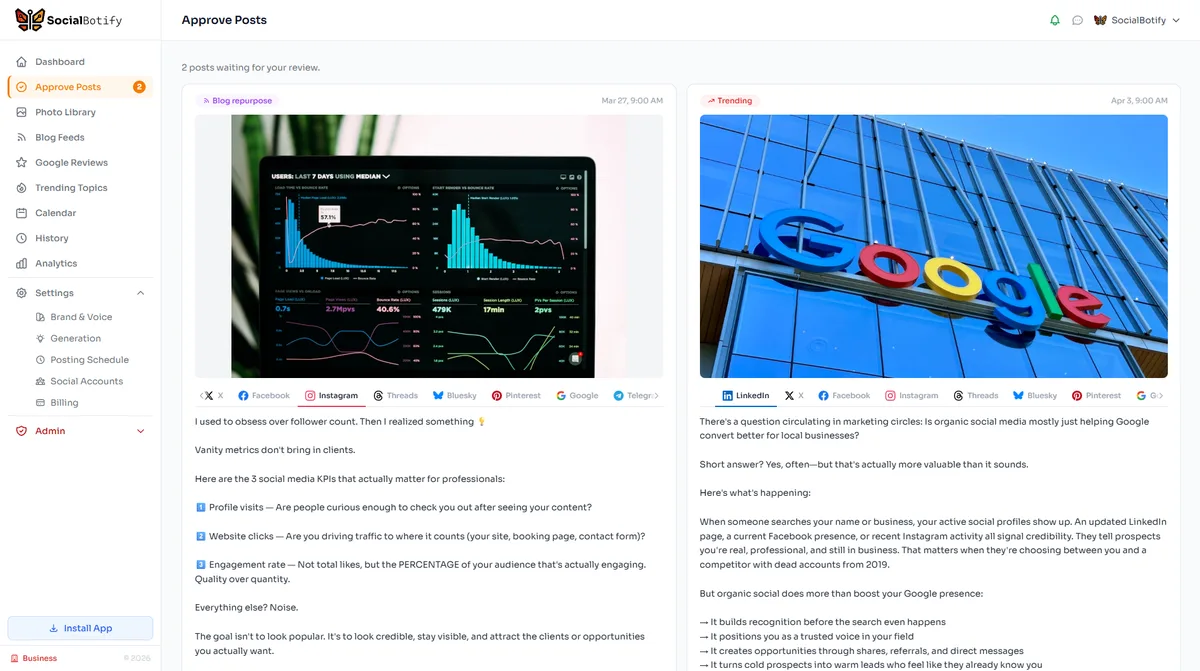
Beat the Algorithm with AI-Powered Posts
SocialBotify generates Instagram content optimized for saves, shares, and engagement, the signals the algorithm cares about most.
Try the Instagram Caption Generator →Grow Your Instagram on Autopilot
SocialBotify creates algorithm-optimized Instagram posts with AI, then schedules them at your audience's peak times.
No credit card required · 7-day free trial · Plans from $19/mo