Social Media Automation Case Study: From 35 Hours to 8 Hours Per Week
How a freelance social media manager reclaimed 27 hours per week while scaling from 3 clients to 8 using AI-powered content automation.
Published March 16, 2026
Key Takeaways
- ✓ Weekly content creation time reduced from 35+ hours to approximately 8 hours
- ✓ 280+ posts scheduled per month across 8 client accounts
- ✓ 40% increase in client posting consistency across all platforms
- ✓ Marketing teams using SocialBotify report saving an average of 6 hours per week on content scheduling

The Challenge: Managing 8 Client Accounts Was Unsustainable
Sarah M. is a freelance social media manager based in Austin, Texas. When she started her freelance business three years ago, she managed three client accounts and handled everything manually. She wrote every caption from scratch, logged into each platform individually, and spent her evenings scheduling posts for the following week. With three clients posting across three to four platforms each, she was already investing 15 to 18 hours per week just on content creation and scheduling. It was manageable, but it left little room for growth. When she landed her fourth and fifth clients, the workload jumped to over 25 hours per week dedicated to content alone. By the time she reached eight clients, each requiring posts across six to eight platforms, the math simply stopped working. She was spending 35 or more hours every week writing, formatting, and scheduling social media content, leaving almost no time for the strategic work her clients actually hired her for.
The quality of her work was suffering too. Posts were going out late or not at all. Some clients received recycled content that did not match their brand voice. Sarah found herself copying and pasting the same post across platforms without adapting it, because there simply was not enough time to write unique versions for LinkedIn, Instagram, Twitter, and Facebook. Hootsuite's annual Social Trends report notes that 65% of social media professionals cite content creation as their most time-consuming task, and Sarah's experience reflected that statistic precisely. She needed a system that could handle the volume without sacrificing the personalized, platform-specific quality her clients expected.
How Did SocialBotify Solve the Multi-Client Content Problem?
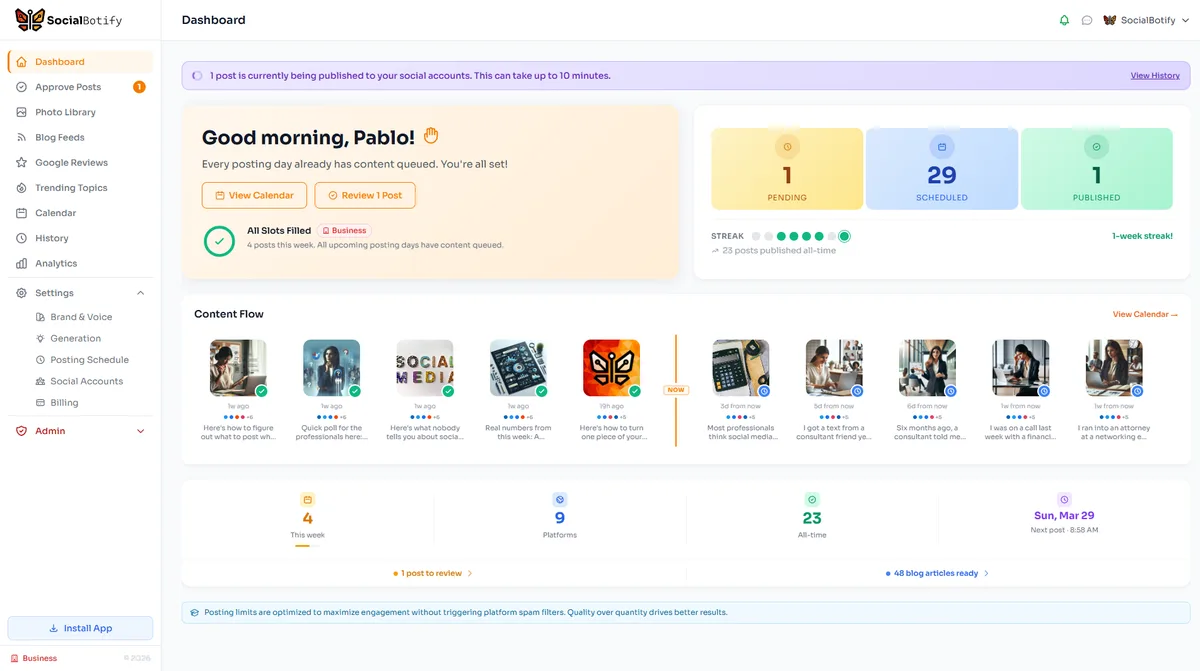
Sarah set up each of her eight clients as a separate brand inside SocialBotify, configuring their individual brand voice, target audience, and content strategy settings. This meant that when the AI content generator produced posts, each one was tailored to the specific client's tone, industry, and audience. A post for her boutique fitness studio client sounded nothing like a post for her B2B software client, even though both were generated by the same tool. She connected all social accounts through the platform's integration system, which meant she no longer needed to log in and out of dozens of accounts across multiple platforms every day.
The workflow shifted from writing to reviewing. Each Monday morning, Sarah would generate a full week of content for all eight clients. SocialBotify's automation engine produced platform-adapted versions of each post, so a LinkedIn article shared a deeper professional insight while the corresponding Instagram caption was conversational and hashtag-optimized. Sarah spent her time reviewing, making minor edits, and approving posts rather than staring at a blank screen trying to come up with ideas. HubSpot research confirms that batch content creation paired with scheduling tools can reduce social media management time by up to 80 percent, which closely mirrors Sarah's experience.
The Results: Measurable Impact Across Every Metric
After three months of using SocialBotify, Sarah's weekly content workload dropped from over 35 hours to approximately 8 hours. That 8-hour figure includes her Monday morning generation and review session, mid-week check-ins to approve any time-sensitive content, and a Friday review of performance metrics. The remaining 27 hours she reclaimed went directly into higher-value work. She took on two additional clients, launched a consulting offering for content strategy, and finally had time to build her own brand's social media presence. Her total monthly output across all eight clients exceeded 280 posts, each one adapted to the specific platform where it appeared. The posting consistency improvement was dramatic. Before SocialBotify, her clients averaged four to five posts per week across all platforms combined. After implementation, that number rose to seven to eight posts per week with zero missed scheduled slots, representing a 40 percent improvement in consistency.
The financial impact was equally significant. By reducing her per-client time investment, Sarah effectively doubled her hourly rate without raising her prices. The time freed up allowed her to grow her client roster and diversify her income streams. LinkedIn's content marketing research shows that professionals who automate repetitive content tasks see an average productivity gain of 3x to 5x, and Sarah's results fall squarely within that range.
What Can Social Media Managers Learn from This Case Study?
The biggest takeaway from Sarah's experience is that the bottleneck in social media management is not creativity or strategy. It is the repetitive mechanical work of turning ideas into platform-specific posts and getting them scheduled on time. When you remove that bottleneck with automation, you do not just save time. You fundamentally change what is possible in terms of scale, quality, and consistency. Marketing teams using SocialBotify report saving an average of 6 hours per week on content scheduling alone, and for freelancers managing multiple accounts, the savings compound quickly. The shift from writing to reviewing is the key mindset change. Instead of generating content from nothing, you are curating and refining AI-generated drafts that already match your client's brand voice and platform requirements. This is faster, less mentally draining, and produces more consistent results.
Ready to Reclaim Your Week?
Join thousands of social media managers who spend less time scheduling and more time growing their clients' brands.
No credit card required · 7-day free trial · Plans from $19/mo